
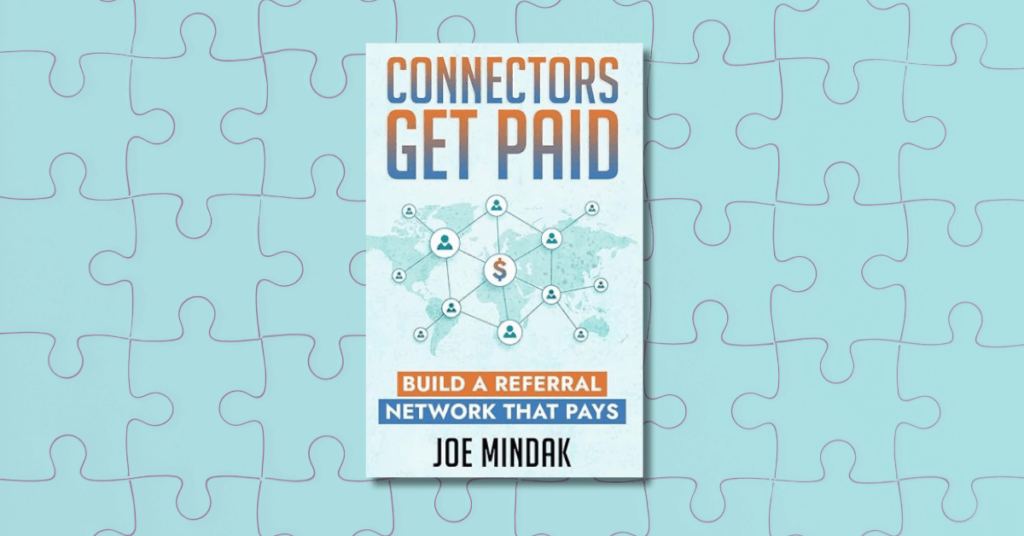
Stop giving away your golden leads for free: A deep dive into Connectors Get Paid
A referral network strategy is essential because we have all been there: handing out valuable introductions like candy, watching others close massive deals based on our trust, and getting nothing but a generic “thank you” card in return.
If you are tired of the old “give to get” philosophy that leaves your wallet empty while your social capital drains away, I have found the playbook you didn’t know you needed. Joe Mindak’s Connectors Get Paid is a refreshing, no-nonsense guide that completely flips the script on traditional networking.
Table of Contents
A New Blueprint for the Referral Network Strategy
The core concept of this book is right there in the title: it is time to professionalize the art of the introduction. Mindak takes us on a journey from his father’s old-school print shop, where business ran on handshakes and Bev-Naps, to the creation of a high-tech, monetized ecosystem. Unlike standard business memoirs that just list successes, Mindak builds a compelling case for a specific referral network strategy: moving away from casual, unpaid referrals toward a structured commission model where the person opening the door gets a fair slice of the pie.
What makes this book unique is its blend of vulnerability and tactical precision. Mindak admits to his “massive mistakes,” including a disastrous “Soup Nazi”-inspired franchise investment and a failed beer company, before finding his true calling as a connector. He argues that your network is an asset, and like any asset, it should generate a return. He isn’t just suggesting you ask for money; he provides the exact math, showing how a standardized split (often 50/50 of the commission) keeps everyone incentivized and happy.
From Handshakes to Software: Elevating Your Referral Network Strategy
I was particularly struck by how the book transitions from soft skills to hard systems. Mindak details the creation of “The Connective,” a networking group that stripped away the fluff of 60-second elevator pitches and focused on curated, B2B relationships. But he didn’t stop at just meeting for coffee; he realized that to scale a referral network strategy, you need infrastructure. The narrative of how he built “Nolodex”—a custom software solution to track deals and automate payments—is fascinating for anyone who loves seeing a side hustle evolve into a scalable tech platform.
The emotional resonance here comes from the author’s genuine desire to see everyone win. He describes the feeling of handing a $14,000 commission check to a member simply for making an intro, changing the paradigm from “favors” to “revenue”. It feels empowering. The book makes you look at your contact list not as a burden of people to keep in touch with, but as a dormant goldmine waiting to be activated.
Who Should Read This?
This book is a must-read for B2B service providers, agency owners, and sales professionals who are exhausted by the lack of ROI in traditional networking groups like BNI. If you are the person everyone calls because “you know a guy,” but you are struggling to monetize that influence, this book is written specifically for you. Mindak provides specific tools, like “The Swarm” for contact mapping and the “Hot List” technique, which are immediately applicable to your own referral network strategy.
It is rare to find a business book that feels this honest about the messiness of entrepreneurship while delivering a clear, replicable system. Mindak proves that you don’t need to be a tech wizard to build a platform; you just need to trust your network and value your own contribution to the deal flow.